Powered By Blogger
Showing posts with label Birdwatching. Show all posts

Friday, October 16, 2015

Large waterfowl on the go

by Peeter Vissak

Cranes are gone by now / Photo: P. Vissak

The very sudden Crane migration wave in the last week of September was perhaps unexpected, but marked the end of the warm "indian summer". When a message from Finland told about 17 thousand cranes starting off from Tampere region and about 14 thousand birds from Pori region, it was like a promise of upcoming crane observation. And they were coming in the daytime and at night, with the NE wind and full moon. Part of these huge flocks, that were starting from Southern Finland, flew straight across Estonia without stopping (a disappointment), but they were in a hurry and had to make their next day ration of 500 km.

Barnacle Geese in gathering sites in Matsalu / Photo: P. Vissak

For birdwatchers there was still the spectacular gathering of different goose species. Tens of thousands of Barnacle Geese and Bean Geese could be watched reciprocating between the feeding areas and resting and sleeping areas. During the latest decades over 100 thousand stopping Barnacle Geese have been annually counted only in the Matsalu region. There are equally good watching locations both in the Northern and Southern coast of Matsalu Bay. With a bus, full of people, we were lucky to watch almost endless flight of geese over the Silurian limestone cliff in Kirbla. 

White-tailed Sea Eagle hunting on geese / Photo: P. Vissak

In the gathering sites passers-by can occasionally watch hunting eagles among thousands of geese taking wing. Despite that West-Estonian fields and coastal meadows are perhaps the best restaurants and hostels for these restless birds on their way.

Aurora borealis in West-Estonia / Photo: P. Vissak

Almost a week ago, late at night, taking long-exposure photographs of Aurora Borealis all over the starry sky, it was almost relaxing to hear the arrived Whooper and Bewick Swans on nearby shallow bays. Next morning observation revealed hundreds of Wigeons and Mallards among them, also some Teals and Goldeneyes. During the upcoming weeks some more thousands are expected to arrive and stay here until the shallow coastal sea is fully frozen.


Wooper and Bewick's Swans in West-Estonia / Photo: P. Vissak


Monday, September 14, 2015

A fantastic new trip for you – just MATSALU!


If one has to choose only one bird area in Estonia, then it should be Matsalu. If one has to choose only one site in Matsalu, it should be Haeska.

So – whyfor?

Maybe it is for Matsalu's 500 km2 territory, its 165 km coastline around the shallow bays, its balanced mixture of small islets, reedbeds, woodlands, floodplains and sea-shore meadows.

Definitely its for unrivalled diversity of migrating and breeding birds and the opportunity to observe it and get personal first-hand experience.

But most of all its the unique feeling of the unobstructed "backyard" of the nature. The feeling of a rediscovered paradise and Yourself  being just there in the right moment and watching it with Your own eyes. Well, mostly with Your binoculars and spotting scope.

So why Haeska? It's very simple – on the ultimate edge of Haeska village You can come to the Tuulingu guesthouse, which stands barely 30 metres off the coast. 


The guesthouse is in fact a rebuilt old farmhouse, now having the front windows and the cafe terrace right towards the shallow sea and the flat muddy coast, where throughout the spring and half of the summer You can watch the swarming birds. Even with Your morning coffee. 


Swans, geese, ducks, grebes, waders, eagles and other birds of prey – all of them fulfilling the panorama. Numerous songbirds in the trees and shrubs, moving past the guesthouse. To get even better panorama You have only to walk 15 metres and climb up the watching tower and almost the whole Matsalu Bay is literally at Your feet.


When You still need some more, it is easily possible to drive around the adjacent locations either in Matsalu National Park or nearby raised bogs, which are just another kind of paradise where the civilization hasn't reached yet. And after some few days it is clear why more than 170 species breed here – and why the north European day-list record of 194 was set in this region in May 2007.

 
We sincerely hope that we gave you the inspiration!


For futher information on a trip MATSALU – a paradise for birds! Please phone or e-mail us for the detailed itinerary. Tel: +372 5349 6695 / E-mail: info@naturetours.ee

250-300 pairs of Three-toed Woodpeckers in one National park in Estonia!


Until now the management of Lahemaa NP knew that their local population of Three-toed Woodpecker is about 25 pairs. Substantial research and monitoring of birds has revealed just the opposite. Three-toed Woodpecker is the second best woodpecker species next to the Great Spotted one. New estimations of the probable abundance are 250-300 pairs!


Three-toed Woodpecker / Photo: Sven Zacek

Woods in Lahemaa suit well also to owls. As it turned out the breeding density of Ural Owl, Pygmy Owl and Tengmalm's Owl is 2-3 times higher than Estonia's average. There are also up to 5 breeding pairs of Eagle Owl in Lahemaa NP.
Intriguingly Hazel Grouse and Nightjar are also among the species of high number (both about 400-500 pairs). These areas occur to be favourable to our Bird of the Year: there are about 15-20 pairs of Honey Buzzard and 70-80 pairs of Common Buzzard. Curiously enough there are practically no Spotted Eagles (just perhaps 1 pair), but the 2 only known North-Estonia's breeding pairs of Osprey are also from Lahemaa.
In rural and agricultural landscapes the most important bird species conservationally speaking is the Corncrake with exeptionally high number (450-500 pairs) and the highest breeding density in our country (up to 10 pairs per km2).


Corncrake / Photo: Mati Kose

As of new breeders in the coastal areas there are now 1-2 pairs of Canada Goose.
The most substantial and labour-intensive one-time bird inventory in Lahemaa NP was carried on from August 2013 till July 2014. Fifteen researchers were participating in this job, among others ENT bird guide Kaarel Võhandu. The elapsed time for these observations was all together 150 workdays and -nights.
This year elaborated bird inventories are carried on in 3 large and 7 smaller Natura Bird Areas. This will bring to completion the goal put up by Estonian Ornithological Society to fill the gaps and gather reliable and relevant fundamental data from all 66 Natura Bird Areas in Estonia.


WOODPECKER TOUR SPRING 2016


Results of Estonian Open 2015

This year Estonian Open took place on the 15th of August from 3 a.m. to 5 p.m. in North-East Estonia. Over 60 participants were registrered for this event with 7 Estonian, 1 Latvian, 1 Lithuanian and 7 Finnish teams. As usual, several Estonian Nature Tours bird guides participated in that event. The winner team was RC & Co from Estonia (including ENT guide Uku Paal)  with 141 species in total. The team Läänemaa Linnuklubi (including our guides Tarvo Valker and Mati Kose) came in fourth place with 136 species. The most interesting species recorded during the rally was Ruddy Shelduck (Tadorna ferruginea).

Photo: Mati Kose

Results of the teams:

1. 141 RC & Co (Andrus Jair, Mihkel Metslaid, Margus Ots, Uku Paal, Peeter Raudsepp)
2. 138 MuoviLabaJengi (Petteri Mäkelä, Tom Nordblad, Jarkko Santaharju, Roni Väisänen)
3. 137 Team Ristisaari (Petri Ripatti, Tuomas Seimola, Ari Vuorio)
4. 136 Läänemaa Linnuklubi (Mati Kose, Renno Nellis, Hannes Pehlak, Tarvo Valker)
5. 133 Banaanivabariik (Jukka Hatva, Tuukka Kupiainen, Jan Nordblad, Gustaf Nordenswahn, Matti Rekilä)
6. 127 Finnish Toy Boys (Sebastian Andrejeff, Paul Boijer, Markus Lampinen, Tomas Swahn, Ossi Tahvonen)
7. 125 Kõrvemaa Suusaklubi (Aki Arkiomaa, Harri Holtta, Matti Koivula, Timo Nuoranen)
8. 123 Kuldkihar ja kolm Karu (Tiina Mäkelä, Juha Tuomala, Henry Tennberg, Jyrki Tolvanen)
9. 114 Natourest (Rein Kuresoo, Leho Luigujõe, Bert Rähni, Ahto Täpsi)
10. 112 Himantopus himantopus (Ilze Bojare, Ivars Brediks, Andris Klepers, Ieva Mardega, Marcis Tirums)
11. 107 Viis Vellot (Madis Karu, Sten Lassmann, Raul Vilk, Kris Voog, Kaarel Võhandu)
12.-13. 103 Bilia (Christer Casagrande, Jaakko Hynninen, Seppo Grönlund, Istvan Kecskemeti)
12.-13. 103 Buteo (Eedi Lelov, Heikki Luhamaa, Kalle Muru, Riho Männik)
14. 101 Eesti Naised (Triin Kaasiku, Liis Keerberg, Aire Orula, Thea Perm, Tiiu Tali)
15. 100 Birding Lithuania (Gediminas Eigirdas, Vytautas Eigirdas, Marius Karlonas, Armandas Naudžius)
16. 75 Westerners (Sander Sirelbu, Ave Huugen)

The total number of species 192.

„Aces“:
Natourest – rukkirääk CRECRE
Birding Lithuania – randtiir STEAEA
Himantopus himantopus – nõmmelõoke LULARB, karvasjalg-kakk AEGFUN, tutt-tiir STESAN, krüüsel CEPGRY, roohabekas PANBIA 
RC & Co – väikekajakas HYDMIN, põldtsiitsitaja EMBHOR
Team Ristisaari – värbrüdi CALTEM, kaelus-turteltuvi STRDEC
Banaanivabariik – rästas-roolind ACRARU, metsis TETURO
Kõrvemaa Suusaklubi – kaljukotkas AQUCHR
Kuldkihar ja kolm Karu – kukkurtihane REMPEN

Video story on the bird race Estonian Open in national TV environmental broadcast...

Estonian Open 2016 takes place on 13th of August in Hiiumaa island. British and other teams are welcome to join this event! 

Wednesday, September 2, 2015

Estonian Nature Tours brochure 2016 is now available

With pleasure, we are continiously offering individual bookings on our fully-inclusive holidays. To order Estonian Nature Tours 2016 brochure please send your contact details (name, address) to our e-mail: info@naturetours.ee


See also the selection of best birdwatching, mammal tours and other wildlife holidays in Estonia available for the year 2015 and 2016 by clicking here...


Monday, March 23, 2015

Garden Birdwatch 2015


Garden Birdwatch 2015 took place on January 23-25 after which the results have been coming in and the final results were published at the beginning of March.  This allowed time for any unusual or problematic sightings to be checked and discussed.
Numbers were slightly down compared to Estonia in 2014 - the total number of birds recorded being 70 376 birds of 63 species mostly in home gardens, but also in parks and graveyards. 2727 people from 1838 locations took part.  This winter the higher than average temperatures and less than average snow fall definitely had its influence and 15 000 fewer individual birds were counted compared to the previous year.
The most interesting species were Great Grey Shrike (4), Little Grebe (3), Mistle Thrush (1) and Dipper (1). The most numerous bird of prey was Sparrowhawk (70), followed by Goshawk (13), Common Buzzard (16) and Pygmy Owl (6).

Great Grey Shrike (Lanius excubitor)
Photo: Valeri Śtśerbatõhh

In the following table counts of the most common wintering garden bird species are presented:


SpeciesTotal number% of locations
Great Tit
17 160
95
Tree Sparrow
10 196
48
Green Finch
8 504
45
House Sparrow
4 365
26
Hooded Crow
3 245
42
Bluetit
2 938
67
Jackdaw
2 805
13
Jay
2 643
23
House Pigeon
1 633
13
Magpie
1 478
38
Marsh Tit
1 460
29
Waxwing
1 379
4
Nuthatch
1 329
41
Willow Tit
1 232
27
Bullfinch
1 216
19
Blackbird
1 071
25
Siskin
864
2
Fieldfare
860
5
Yellowhammer
785
6
Mallard
627
1


Original data by Aarne Tuule (Newsletter of the Estonian Ornithological Society - “Tiirutaja” No 28, 2015)

Sunday, February 15, 2015

Bird species list of Estonia


The checklits of birds recorded in Estonia is currently at 385 species (categories
A..C), and can be found on the website of the Estonian Ornithological Society (EOÜ)


A new addition to the list was Lesser Short-toed Lark (Calandrella rufescens):
04.06.2014 Rammu island, Harju County (Riho Männik, Monika Laurits-Arro,
Jaanus Aua).


Lesser Short-toed Lark (Calandrella rufescens)
Rammu island, Harju county, 4.6.2014. First for Estonia.
Photo: Riho Männik

In addition to that Mandarin Duck (Aix galericulata) was transferred to the main list. Mandarin Duck was in category E as all records were considered cagebird escapes, but as there are now numberous birds breeding in the country it has been moved to category C - species and subspecies that are introduced or considered to have a self-sustaining population based on specimen escaped from captivity, also species, that occur here from similar populations outside Estonia. There are wild populations of Mandarin Duck in several places in Europe, the nearest regular breeding area being e.g. in Poland. Also in Finland the Mandarin Duck was recently moved to category C. This means that in Estonia there are 3 species now in category C: Canada Goose, Mandarin Duck and Feral Pigeon.
All the confirmed sightings of each species and subspecies, handled by the Rarities Commission can be viewed here...


Thursday, October 16, 2014

EuroBirdWatch 2014


The international birdwatching event EuroBirdwatch 2014 on the weekend of 4-5 October was attended by 40 countries from Europe and Central Asia. In Estonia, over 300 people participated in the event and collected 98 sighting lists, the longest of which was 111 species of birds. At several places in Estonia it was also possible to join a guided birding trip. During the weekend over 400,000 birds of 166 species were observed..
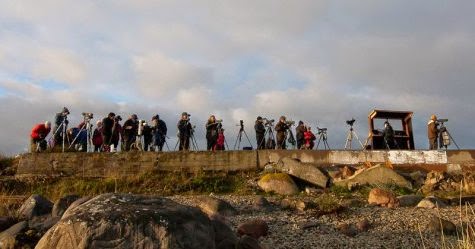
Despite the beautiful weather the passerine migration was not great and inland the number of the birds was extremely low. But the situation was totally different near the sea. At Põõsaspea Cape, the international event celebrated by 60-70 birdwatchers from Estonia and abroad saw some superb migration with the season's best counts: nearly 90,000 birds in all. An early passage of Long-tailed Duck produced 58,000 birds with smaller, but still impressive, numbers of Velvet Scoter (5,500), Wigeon (6,300), Pintails (1,050), Scaup (2,300), Red-throated Diver (720), Barnacle Goose (6,800) and Brent Goose (2,180). Also worth mentioning are Dunlin (133) and Grey Plover (32). 

Photo: Aki Aintila

Other species seen in good numbers include Great Tit, Hooded Crow, Black-billed Magpie, Eurasian Jay and Great Spotted Woodpecker and more interesting species were Yellow-browed Warbler, Common Guillemot and Hoopoe. Quite a lot of migratory species that should have already left Estonia were also seen, such as Shelduck, White Stork, Honey Buzzard, Eurasian Curlew, Black Tern, Spotted Flycatcher, Common Redstart, Serin, Sedge Warbler, Blackcap and Penduline Tit.

Friday, September 26, 2014

ENT bird guide Tarvo Valker participated in the Batumi Bird Festival


From 15 to 21 September a Bird Festival took place in Batumi (Georgia), where Estonia was reperesented by a birding expert Tarvo Valker. Tarvo stood up with two presentations:  „Spithami - a major flyway for the arctic waterfowls“ and „Nature conservation in Estonia“.


It was already fourth time of this birdwatching event to take place. Batumi is located at the Black Sea coast, which is a major bottleneck for several million birds on their journey from breeding grounds to wintering areas. The aim of this event was to promote this birding area for wider public and encourage more birders to visit that unique hotspot.

Besides Estonia experts from Belarus, Armenia and Azerbaidjan were invited. Several field trips were made together with local stakeholders - including visiting famous Batumi raptor watching point, opening new bird tower at Mtirala National Park and visiting several other nature conservation areas. In the evening the conference was held where experts from abroad shared their excperience in birdwatching and nature conservation work.

It was corporately confirmed by the participants, that Batumi has a huge potential in birdwatching and ecotourism. The main problems are lack of local birders and also massive hunting, including on many endangered bird species. Certainly Batumi Bird Fest will take place also in next autumn.

See also a gallery of Batumi Raptor Count Autumn 2014


Migrating Black Storks / Tarvo Valker

There are still many falconers in Georgia / Tarvo Valker

Over one million raptors pass through Batumi every autumn / Tarvo Valker

Tarvo Valker is on the left side

Tarvo Valker is on the left side

Tarvo Valker is on the left side


Thursday, September 25, 2014

ENT linnugiid Tarvo Valker osales Batumi Linnufestivalil


15.-21.septembril toimus Batumis (Gruusia) linnufestival, kus Eestit esindas eksperdina ENT giid Tarvo Valker. Tarvo tegi festivali ajal kaks ettekannet: „Spithami - a major flyway for the arctic waterfowls“ ja „Nature conservation in Estonia“.


Batumi linnufestivali peeti tänavu juba neljandat korda. Ürituse eesmärgiks on välisekspertide abiga juhtida tähelepanu Musta mere rannikul paiknevale tähtsale lindude rändekoridorile ja meelitada Gruusiasse enam linnuturiste. Üritust olid kajastamas ka mitmed kohalikud telekanalid.

Üritusel osalesid lisaks Eestile veel väliseksperdid Valgevenest, Armeeniast ja Aserdaidžaanist. Päeval külastati üheskoos kohalikega kuulsat röövlindude vaatluspunkti, avati uus linnuvaatlustorn Mtirala rahvuspargis ning toimusid ekskursioonid erinevatele kaitsealadele. Õhtuti peeti konverentsi, kus väliseksperid rääkisid enda riigi loodusest ja loodushoiust.

Üheskoos tõdeti, et Batumi piirkonnal on väga suur potentsiaal linnu-ja ökoturismi arendamiseks. Peamisteks kitsaskohtadeks on kohalike linnuvaatlejate vähesus ning aktiivne linnujaht, mille käigus tapetakse ka mitmeid ohustatuid linnuliike. Kindlasti peetakse Batumi linnufestivali ka tuleval aastal.

Vaata ka Batumi Raptor Count Autumn 2014 galeriid...
 

 Rändavad must-toonekured / Tarvo Valker
 
 Jahikullide pidamine on Gruusias jätkuvalt väga levinud / Tarvo Valker

Batumist möödub igal sügisel miljon röövlindu / Tarvo Valker

Tarvo Valker on vasakul

Tarvo Valker on vasakul

Tarvo Valker on vasakul


Thursday, August 21, 2014

Bird race Estonian Open – 167 species in 14 hours is a new record!


The Estonian Open birdrace takes place every August. This year was the 20th annivessary of this international race, with teams from Finland and Latvia also taking part. An impressive 23 teams with 95 participants joined the great birding event.

The race started at 3 a.m and every team had exactly 14 hours to gain the biggest bird list. As with most bird races, to have a tick, more than a half the team members need to see or hear the species.

Because of the anniversary, this year the race area was the whole of Estonia. The winning team Spithman, (including two Estonian Nature Tours bird guides Margus Ellermaa and Tarvo Valker), chose Läänemaa county as their area. It was mixed team – beside Margus and Tarvo, the team included three Finns (Juho Könonen, Aki Aintila and Markus Lampinen). They put the secret of their success down to top birding skills and an excellent knowledge of the local patch, plus of course running at many sites, to avoid loosing valuable time. Two owl species were ticked within the first 5 minutes, and by mid-day, the team list was already nearly 150 species!

 Making of summaries (Tarvo Valker is in the middle in the front row) / Uku Paal

Even during the last half a hour, the winning team managed to tick two more species – Lesser Spotted Eagle and then just 10 minutes before the end, they added a Turtle Dove to the list. The team result of 167 species beat the previous record total by 12 species. The second-placed team had 152 species, so it turned out to be biggest margin of victory between two teams ever. If you consider that birds in August are not vocal and it wasnt 24 hours bird race, it is amazing result, showing the great birding potential of the country!

NB! It is important to realize that birding records are done in May, while in August birds are less vocal and gaining high list is far more challenging.

Results of the teams:

1. 167 Spithamn (Aki Aintila, Margus Ellermaa, Juho Könönen, Markus Lampinen, Tarvo Valker)
2. 152 MuoviLabaJengi (Teppo Lehtola, Petteri Mäkelä, Tom Nordblad, Jarkko Santaharju, Roni Väisänen)
3. 150 Takaveto (Vesa Jouhki, Andreas Linden, Jukka Salokangas, Andreas Uppstu, Peter Uppstu)
4. 148 Team Ristisaari (Petri Ripatti, Kari Soilevaara, Petteri Tolvanen, Ari Vuorio)
5. 146 Himantopus Himantopus (Ivars Brediks, Andris Klepers, Ieva Mārdega, Mārcis Tīrums)
6. 143 Sylvia (Mika Bruun, Asko Rokala, Roland Sundström, Ari Veijalainen)
7. 141 Nahkhiirmees (Jan Nordblad, Timo Pettay, Matti Rekilä, Juha Sjöholm, Erkki Valsta)
8. 139 Bad Company (Kuido Kõiv, Mati Salumäe, Tiit Vohta)
9. 138 Länemaa Linnuklubi (Trinus Haitjema, Mati Kose, Renno Nellis, Hannes Pehlak)
10. 137 Eesti Naised (Mariliis Märtson, Marju Erit, Triin Kaasiku, Aire Orula, Reet Rannik)
11.-12. 136 FC Fallos (Heikki Eriksson, Jukka Hatva, Juha Laaksonen, Pasi Pirinen, Tuomas Seimola)
11.-12. 136 V5 (Madis Karu, Raul Vilk, Kris Voog, Kaarel Võhandu)
13. 133 RC&Co (Margus Ots, Uku Paal, Ranno Puumets, Peeter Raudsepp)
14. 132 Vantaa (Heikki Luoto, Leena Luoto, Biti Ojala, Markku Ojala)
15. 132 Kõrvemaa Suusaklubi (Aki Arkiomaa, Johan Hassel, Jari Kårlund, Timo Nuoranen)
16.-17. 124 Kuldkihar ja kolm Karu (Tiina Mäkelä, Henry Tennberg, Jyrki Tolvanen, Juha Tuomaala)
16.-17. 124 Bilia (Christer Casagrande, Seppo Grönlund, Jaakko Hynninen, Istvan Kecskemeti)
18. 122 FC Pullus (Ilpo Hanski, Ilpo Huolman, Martti Vattulainen, Erkki Virolainen)
19. 120 Buteo (Eedi Lelov, Heikki Luhamaa, Riho Männik, Kalle Muru)
20. 115 Unioni (Risto Lammin-Soila, Tuomas Lukkarinen, Petteri Uusivouri)
21. 101 Sunset ökoriders (Timo Böhme, Lauri Mäenpää, Minna Mäenpää, Leena Törnqvist)
22. 99 Male&Female (Ave Huugen, Sander Sirelbu)
23. 97 Qkakk (Martin Piispea, Rene Ottesson, Meelis Suurkaev)

The total number of species 206.

„Aces“:

MuoviLabaJengi – Caspian Gull (Larus cachinnans), Red-necked Phalarope (Phalaropus lobatus), Ortolan Bunting (Emberiza hortulana)
Team Ristisaari – Blyth's Reed Warbler (Acrocephalus dumetorum)
Himantopus Himantopus – Common Kingfisher (Alcedo atthis)
Sylvia – European Penduline Tit (Remiz pendulinus)
Bad Company – Great Bittern (Botaurus stellaris)
Eesti Naised – Parrot Crossbill (Loxia pytyopsittacus)
RC&Co – Grey Partridge (Perdix perdix), Common Redpoll (Acanthis flammea)
Vantaa – Eurasian Collared Dove (Streptopelia decaocto)
Kuldkihar ja kolm Karu – Grey Wagtail (Motacilla cinerea)
Bilia – Eurasian Eagle-owl (Bubo bubo)
Buteo – Greater Spotted Eagle (Aquila clanga)
Qkakk – Black Kite (Milvus migrans)


Tuesday, February 4, 2014

Talvine aialinnuvaatlus on kõige populaarsem linnuvaatlusüritus Eestis


Jaanuarikuu viimasel nädalavahetusel viiendat korda toimunud talvisel aialinnuvaatlusel vaadeldi esialgsetel andmetel kokku üle 85000 linnu ligemale 60 liigist. Oma vaatlused on tänaseks edastanud üle 3600 linnusõbra, kes tegid aialinnuvaatlusi 2500 erinevas paigas  üle Eesti. Lõplik kokkuvõte avaldatakse märtsi alguses.

Eelmisel aastal olid tulemusteks vastavalt 65000  lindu, 2500 osalejat ja 1800 erinevat paika. Linnuvaatluse populaarsuse kasvu ilmestab seegi, et pooled vaatlejad osalesid sel aastal aialinnuvaatlusel esimest korda.

Arvukam liik oli taas rasvatihane, kes moodustas üle 24% vaadeldud lindude koguarvust. Sarnaselt eelmistele aastatele mahtusid esiviisikusse veel põld- ja koduvarblane, rohevint ja leevike. Paljude vaatlejate tähelepanekute kohaselt soosisid ilmaolud lindude vaatlemist ja nii mõneski kohas nähti tavapärasest rohkem linde. Põnevamatest liikidest kohati hallhaigrut, värbkakku, hallõgijat ja tänavust aasta lindu jäälindu.

 Rasvatihane (Parus major) / Lembit Michelson


2014.aasta vaatlused leiad siit: http://www.eoy.ee/talv/vaatlused/

Talvine aialinnuvaatlus pälvis 2013.aasta keskkonnateo tiitli. Loe lähemalt...       
Talvine aialinnuvaatlus on suurim kodanikuteaduse projekt Eestis. Loe lähemalt...